Access Control and Visitor Management Integration: How Acre Brings Them Together
.webp)
Most organizations run two separate systems: one that manages who enters a facility, and another that tracks visitor movements while they're inside. These systems rarely talk to each other. The result is fragmented workflows, duplicated effort, and security gaps that make it harder to maintain control.
Integrating access control and visitor management changes that equation entirely. When these systems work together, security teams gain real-time visibility into both who is authorized to enter and where they can go once they're inside. Check-in processes become faster. Compliance becomes easier to prove. And your security posture strengthens across the entire facility.
Note: If your visitor management and access control systems operate independently, creating gaps in who has access, where they can go, and whether that data is being tracked accurately. Talk to the Acre team to see how Acre's integrated visitor management and access control platform gives you a single, unified record of every person on your premises.
Why Integration Matters
Standalone systems create operational friction. A visitor arrives and checks in at the reception desk. The receptionist hands them a temporary badge. That badge activates on an access control reader at the door. But if the visitor tries to enter an area they're not approved for, the system blocks them without context. The guard at that door has no way to know whether the denial was intentional or a configuration error. Meanwhile, if the visitor leaves without properly checking out, the access control system doesn't automatically revoke their credentials.
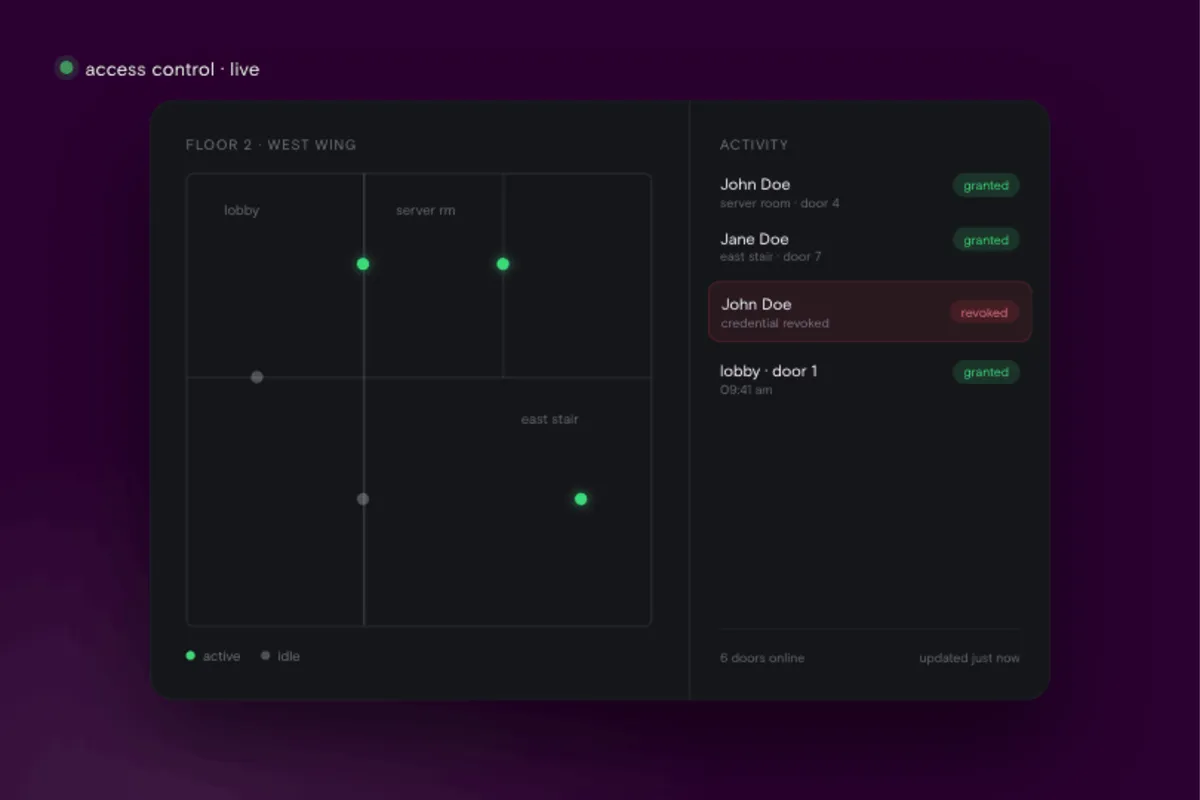
With integration, every piece of information flows in one direction: from the visitor management platform to the access control system, and back again. When a visitor checks in, their approved access rights are immediately reflected in the AC system. When their visit window closes, they're automatically denied access. Security teams see a unified timeline of who was where and when.
What Access Control Does
Access control systems manage the fundamental security function: deciding who can and cannot enter a facility or specific area. They use hardware like card readers, biometric scanners, or mobile credentials to verify identity. Once verified, the system either grants or denies access based on the credentials presented and the rules configured by security teams.
Modern access control also tracks entry events. Every time someone successfully enters a space or attempts to enter and is denied, that event is logged. This audit trail becomes crucial for compliance investigations, incident response, and understanding occupancy patterns.
What Visitor Management Does
Visitor management systems handle the reception and tracking side of security. They digitize the paper sign-in sheet. A visitor arrives, checks in on a kiosk or mobile app, and the system records their identity, the person they're visiting, and the time they arrived. From there, the system can issue a temporary badge, notify the host that the visitor is waiting, and maintain a digital log of visitor movements throughout their stay.
For facilities with significant visitor traffic, this becomes a major operational tool. It automates the check-in process, reduces administrative overhead, and creates a searchable record of who was on-site and when. For security teams, it provides context that access control logs alone cannot offer.
The Gap Between Them
Without integration, these systems operate independently. A visitor management system might know that John Smith visited Building A from 2 to 4 p.m. on Tuesday. The access control system might show that a visitor badge accessed Door 3 at 2:15 p.m. and Door 8 at 3:45 p.m. But connecting those two data points requires manual correlation. If someone leaves without checking out, the access control system doesn't know the visitor's session has ended and may continue allowing their badge to function beyond their authorized visit window.
This gap creates several problems. Security teams waste time reconciling data from separate systems. Temporary credentials don't expire on schedule, creating lingering security exposure. And in an emergency, it takes longer to account for who is actually inside the building.
How Acre Integrates Both
Acre's approach is straightforward: Acre Enterprise Visitor Management connects directly to Acre's access control platforms, allowing both systems to share data in real-time. When a visitor checks in through the Acre Visitor Management platform, their approved access rights are immediately written to the access control system. When they check out or their authorized visit window expires, access is automatically revoked.
This integration works across Acre's entire range of access control products. Whether your organization runs Acre Access Control (the cloud-native enterprise platform), ACT365 (for distributed sites), or ACTpro (on-premises deployment), Acre Visitor Management connects seamlessly. The result is one unified security workflow: visitors self-service through check-in, receive temporary credentials, and access flows are enforced automatically.
The foundation of this integration is a properly configured access control system. If you're planning to implement integrated access control and visitor management, understanding the fundamentals of installing access control systems ensures your integration deployment goes smoothly. Acre's technical team can guide you through hardware placement, reader configuration, and network setup so the integration activates without disruption. The result is one unified security workflow: visitors self-service through check-in, receive temporary credentials, and access flows are enforced automatically.
Enterprise Visitor Management: Core Features in the Acre Integration
Acre Enterprise Visitor Management is built for organizations that need to track large volumes of visitors across multiple sites. The platform streamlines every step of the visitor lifecycle.
Pre-registration speeds up the check-in process significantly. Visitors receive digital invites and can pre-register before they arrive. When they show up, check-in takes seconds. Self-service kiosks or tablets display visitor information, capture a photo, and print a temporary badge or send a QR code to the visitor's phone. The system generates reports in real-time so security teams know exactly who is on-site at any moment.
For organizations with multiple buildings or campuses, Acre Visitor Management scales across sites without adding complexity. Configuration flows, notification rules, and approval workflows adapt to different buildings and visitor types.
Access Control Platforms: Acre's Range
Acre offers multiple access control platforms to fit different deployment requirements. Acre Access Control is the cloud-native enterprise platform, offering centralized management, mobile credentials, real-time alerts, and analytics dashboards. ACT365 targets distributed sites and remote management scenarios, with an open API for integrating Time and Attendance systems. For organizations that require on-premises deployment, ACTpro provides enterprise-grade access control within your own infrastructure.
Regardless of which platform you choose, Acre Visitor Management integrates with all of them. Temporary visitor credentials activate in your access control system immediately upon check-in. Your security operations team sees unified event logs from both systems in one place.
Real-Time Visitor Tracking and Access Control
Integration enables real-time visibility. When a visitor enters a facility, both systems update immediately. The visitor management platform knows they've been granted access. The access control system knows the specific visitor who just entered and their approved access level. If a visitor tries to access an area they're not permitted to enter, the access control system denies them, and the denial is logged in both systems.
In an emergency situation, this unified visibility becomes critical. Security teams can see exactly who is currently in each area of the facility without having to cross-reference multiple systems. Evacuation accountability takes minutes instead of hours.
Streamlined Check-In Workflows
Before integration, the check-in process required multiple touchpoints. A visitor arrived and spoke to reception. The receptionist manually entered information into the visitor management system, printed or activated a badge, then sent the visitor to another station to activate that badge in the access control system. The entire process could take ten minutes or longer.
With Acre's integration, visitors arrive and check in on a self-service kiosk. They provide their name, the person they're visiting, and scan or confirm a photo. The system immediately activates their temporary credentials in the access control system. They pick up their badge and head directly to the door. The entire process takes two minutes.
This streamlined workflow improves the visitor experience and reduces administrative overhead for security teams. It also reduces the number of touchpoints where errors can occur.
Automatic Access Expiration and Security Enforcement
One of the most important benefits of integration is automatic access expiration. When you set a visit window in the visitor management system, the access control system enforces that window automatically. If a visitor is approved to be on-site from 2 p.m. to 4 p.m., their credentials will automatically stop working at 4 p.m. If they attempt to re-enter after that time, they will be denied.
This enforcement happens without any manual intervention from security teams. There's no need to remember to revoke temporary credentials when a visitor leaves. The system handles it. If a visitor forgets to check out, their access is still revoked on schedule. Security remains maintained at all times.
The Migration Question: How to Modernize Without Disruption
Many organizations considering this integration already run legacy access control systems. The prospect of migrating to a modern platform raises concerns: How do we avoid disruption? How do we protect our existing investment? Can we transition gradually?
Acre Bridge answers these questions. Bridge is a hardware device that connects legacy on-premises access control systems directly to Acre Access Control, the cloud platform. This allows both environments to run in parallel while synchronizing people, devices, and events across both.
Acre Bridge: The Practical Migration Path
Rather than forcing a rip-and-replace decision, Acre Bridge lets you begin adopting modern capabilities like centralized management, mobile credentials, and stronger operational visibility while continuing to build on the infrastructure already in place. You don't have to migrate your entire access control estate overnight. You can start small: enable the integration at one facility or one entrance, prove value, then template that success across the organization.
This phased approach reduces disruption, protects prior investment, and gives security teams time to learn new workflows before expanding integration across the entire facility.
Deployment Flexibility: Cloud, On-Premises, or Hybrid
Organizations have different requirements. Some need everything in the cloud for operational simplicity. Some require on-premises access control for regulatory or infrastructure reasons. Many operate hybrid environments where some systems are cloud-native and others remain on-premises.
Acre supports all three models. You can run Acre Access Control entirely in the cloud. You can run ACTpro on-premises for sovereign access control, while connecting Acre Visitor Management in the cloud for faster visitor workflows. You can use Acre Bridge to synchronize a legacy on-premises system with a cloud-native platform. The integration works regardless of where each system lives.
This flexibility means you're never forced into a deployment model that doesn't fit your organization. You deploy at your own pace, following a path that respects your existing infrastructure, regulatory requirements, and operational reality.
Security Benefits of Integration
Integration raises your security baseline. By unifying visitor management and access control, you eliminate the blind spots created by separate systems. You know not just that someone entered a building, but who they are, who they were visiting, and which areas they accessed. You can track visitor movements through multiple access points and identify unusual patterns. And you can revoke access immediately if a security concern arises, knowing the revocation applies across all access points.
Operational Efficiency Gains
Beyond security, integration reduces the manual work that security teams perform every day. Temporary credentials no longer require manual activation and revocation. Visitor logs are automatically generated. Compliance reports pull data from a unified system rather than requiring manual reconciliation of multiple sources. Support staff spend less time answering questions about access or visitor status because the system provides clear, real-time answers.
Organizations report measurable reductions in administrative overhead and faster resolution of access issues when they integrate these systems.
Getting Started with Access Control and Visitor Management Integration
If you're considering integration, start by assessing your current environment. Do you have access control in place? Do you currently manage visitors manually or with a standalone system? What does your deployment infrastructure look like? These answers determine which Acre products fit your organization and which deployment model makes sense.
The next step is typically a proof of concept: implement integration at a single facility or entrance, measure the outcomes, and use that success as the foundation for broader rollout. This approach lets you validate the integration without betting the entire security infrastructure.
Ready to Simplify Your Security
Integrating access control and visitor management eliminates the operational friction created by separate systems. Your team spends less time on manual security tasks. Visitors move through your facility faster. Security visibility improves. And you maintain control over exactly who is on your premises and where they can access.
Acre makes integration straightforward, whether you're starting from scratch or modernizing legacy systems. Talk to the Acre team to see how integration fits your organization and which deployment path makes sense for your environment.
Frequently Asked Questions
Can we integrate if we already have legacy access control in place?
Yes. Acre Bridge connects legacy on-premises access control systems directly to Acre Access Control, allowing both to run in parallel while synchronizing credentials and events. You can integrate at your own pace without ripping and replacing your existing infrastructure.
How long does a temporary visitor credential remain active?
You set the expiration when the visitor checks in. A visitor might be granted access for their specific meeting time, or for the entire business day. When the expiration time arrives, access is automatically revoked. If a visitor fails to check out manually, the system still enforces the automatic expiration.
Does integration require cloud deployment?
No. While Acre Visitor Management is cloud-based, it integrates with Acre's cloud and on-premises access control platforms. You can keep your access control on-premises and connect visitor management in the cloud. You can also run everything on-premises if your environment requires it.
What happens if a visitor arrives at an unexpected entrance?
The access control system only grants access based on the permissions assigned during check-in. If a visitor tries to enter through a door they're not approved to use, they will be denied. This is intentional: it prevents visitors from accessing restricted areas.
How do we handle contractors or vendors who need multi-day or recurring access?
Acre Visitor Management supports custom workflows. You can set up recurring visitor profiles, multi-day authorization windows, and role-based access permissions. Contractors can check in once and have their credentials remain active for their approved period without needing to re-check-in each day.
Is audit compliance easier with integration?
Significantly. With a unified system, compliance reports pull data from a single source rather than requiring manual correlation of multiple systems. You have a complete audit trail showing who was on-site, when they arrived, where they accessed, and when they left. This unified log makes compliance investigations faster and more defensible.

.webp)
.jpg)