
Best Cloud-Based Access Control Systems: The Top 8 in 2026
.webp)
Managing physical access across distributed sites has become one of the more complex operational challenges in enterprise security. Organizations running multiple locations, hybrid workforces, and compliance-sensitive environments need access control systems that offer real-time visibility, remote administration, and the ability to respond to security events instantly, regardless of where the security team is based. Traditional on-premises systems were not designed for that operating reality. Cloud-based access control is.
A cloud-based access control system manages physical access through an online platform rather than a local server. Administrators can issue credentials, monitor activity, and enforce policies across multiple sites, all through a secure, centralized interface accessible from any device with an internet connection.
This guide covers the top cloud-based access control systems available today, what they offer, where they differ, and what to prioritize when evaluating platforms. If you want to understand how Acre measures up against your specific requirements,.
Note: If you are evaluating cloud-based access control platforms and want to understand how Acre performs against your specific requirements, whether that is multi-site management, compliance, or migrating off a legacy system, then a conversation with an Acre specialist is the fastest way to get a straight answer. Talk to the Acre team here.
The Top 8 Cloud-Based Access Control Systems in 2026
Each platform below has been selected based on breadth of capability, deployment flexibility, integration ecosystem, and suitability across a range of organization types and sizes.
1. Acre Security — Best for Any Deployment Model, Any Scale
Acre Security sits at the top of this list for one reason that separates it from every other platform: it is the only provider on this list that can deliver cloud-native access control, on-premises access control, and hybrid deployments from a single, unified portfolio, without requiring you to choose a different vendor depending on your infrastructure.
For most cloud-based access control vendors, 'cloud' is the only option. If your organization requires on-premises deployment for regulatory, sovereignty, or network-isolation reasons,l or runs a hybrid environment where some sites need local control while others are centrally managed, your options narrow quickly. Acre solves this at the portfolio level.
What separates Acre from most competitors on this list is the breadth of the platform beyond the access control layer. Acre's portfolio includes Enterprise Visitor Management for controlled, auditable visitor and contractor access; acre Intrusion for intelligent detection of threats that bypass access controls; and comnet by acre for the hardened network infrastructure that keeps every component running reliably. These are not third-party integrations bolted on, they are purpose-built components of the same ecosystem.
Acre is trusted by organizations including Google, Pinterest, Dublin Airport Authority, The Ritz London, and a global media company with 150+ sites.
Transition at Your Own Pace — No Rip-and-Replace Required
One of the most common concerns when evaluating a new access control platform is migration risk. Replacing a live system across multiple sites is a significant operational undertaking, and the fear of disruption is legitimate. Acre’s approach is built around that reality.
Acre does not require organizations to migrate everything at once. The standard adoption path is: start with a single door or a single site, prove value, then template and scale. Acre teams regularly run proof-of-concept pilots, single-door or 4-week trials, before broader rollouts. Remote pre-configuration and deployment reduce site downtime. Multi-site templates accelerate replication once the initial site is validated.
Open APIs and broad integration support also mean that existing infrastructure does not have to be discarded. Acre integrates with existing readers, HR and time-and-attendance systems, VMS and PSIM platforms, and workplace tools, so organizations can retire what no longer serves them and keep what does. The practical framing: integrate what works, replace what doesn’t, on a timeline that suits the business.
For organizations that cannot move to cloud at all, because of regulatory constraints, network isolation requirements, or heritage building limitations — ACTpro delivers fully on-premises access control with no cloud dependency. When those constraints ease, or when different parts of the estate have different requirements, Acre supports a phased move to hybrid or full cloud without changing vendors.
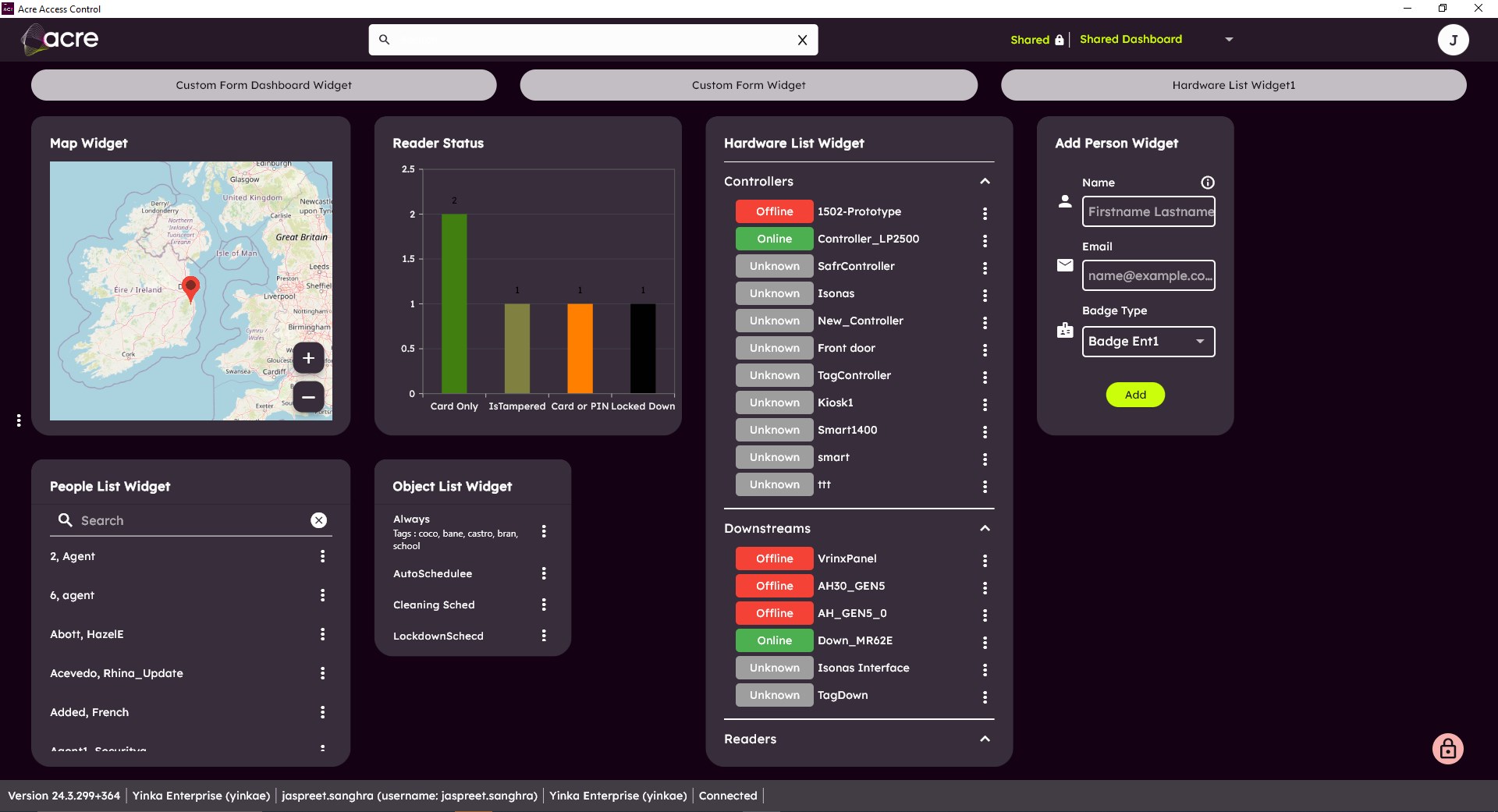
Cloud, On-Premises, or Hybrid: One Platform, Every Deployment
Acre's access control portfolio spans three distinct deployment models, each purpose-built rather than retrofitted:
- Acre Access Control is the cloud-native enterprise platform. Multi-site administration, real-time alerts, analytics dashboards, mobile and biometric credentials, and a broad integration ecosystem — all delivered as SaaS on AWS.
- ACT365 is Acre's cloud-managed access control system for distributed and industrial environments. Open API for time and attendance integration, fire muster workflows, and unlimited doors by design. Ideal for contractor-heavy or multi-building sites. Learn more here: acresecurity.com/access-control/act365
- ACTpro is Acre's on-premises, controller-based access control system for organizations that require local, sovereign, or air-gapped control. Proven at large door counts; deployed in government estates, heritage buildings, and highly regulated environments.
- Hybrid deployments combine on-premises access control with cloud visitor management or cloud monitoring, a common pattern in government and regulated facilities where some infrastructure must remain local but operational efficiency still matters.
The practical implication: an organization can run ACTpro at a secure government facility, Acre Access Control at its corporate offices, and ACT365 at its industrial sites, all managed within the same ecosystem, with shared integrations and a consistent security posture.
What Acre Covers Beyond the Access Control Layer
Where most access control vendors stop at the door controller, Acre's portfolio extends to the full physical access control security stack. This matters because access control does not operate in isolation, threats that bypass door readers, unmanaged visitor flows, and unreliable network infrastructure all create gaps that a standalone access control system cannot close.
- Enterprise Visitor Management (EVM) — digital invitations, self-service kiosk and tablet check-in, QR scanning, host notifications, badge printing, and 125+ workplace integrations including Outlook, Teams, and Google Workspace. Auditable logs and privacy controls for compliance-driven environments.
- Acre Intrusion (SPCevo) — professional intrusion detection panels with door control integration, cloud installer portal (SPC Connect), and tiered management licenses for multi-panel deployments. Unified alarm and access workflows for sites that need both layers working together.
- Comnet by Acre — industrial Ethernet switches, media converters, edge computing and video storage appliances, and remote monitoring tools (Razberi Monitor). The hardened network infrastructure that keeps every security component running reliably, including TAA/NDAA-compliant switch options.
These are not third-party integrations bolted on after the fact. They are purpose-built components of the same ecosystem, designed to work together and managed through connected workflows.
Acre's Key Capabilities
- Cloud-native platform built on AWS for enterprise uptime and data protection
- Mobile credentials via Acre Wallet, secured by Face ID or fingerprint (BLE and NFC)
- Role-based access control with granular, site-level permissions
- Real-time monitoring, alerts, and comprehensive access logs
- System-wide lockdown and mass notification capabilities
- Automatic software updates and security patches across all cloud deployments
- SOC 2-aligned cloud access control; GDPR data protection posture across the platform
- Native integration with Acre Intrusion, Enterprise Visitor Management, and Comnet by Acre
- Supports cloud (Acre Access Control, ACT365), on-premises (ACTpro), and hybrid deployment models
- Smart Controller for cost-optimized cloud AC deployment at SMB scale
Who Uses Acre
Acre is trusted by Google, Pinterest, The Ritz London, Dublin Airport Authority, Rockhurst University, and a global media company managing access across 150+ sites. Its customer base spans education, healthcare, commercial real estate, government, critical infrastructure, and Fortune 500 enterprises.
If you are evaluating cloud-based access control and need to understand how Acre fits your specific infrastructure — whether cloud, on-premises, or hybrid — talk to the Acre team.
2. ADT — Best for Professionally Monitored Security
ADT provides a comprehensive, cloud-managed security and access control platform combining intrusion detection, video surveillance, smart access, and 24/7 professional monitoring. Its strength is in environments that require a human response layer — live agent verification, professional monitoring centers, and emergency coordination — rather than self-managed security operations.
- Centralized control with real-time alerts via the ADT+ mobile app
- Video verification with live agent support for faster emergency response
- Smart locks, video intercom, and sensor integration for multi-site coverage
- 24/7 professional monitoring from ADT security centres
- Integration with smart building systems and enterprise networks
ADT suits retail, education, and enterprise environments where outsourced monitoring is a core part of the security strategy.
3. ButterflyMX — Best for Property Managers & Owners
A full‑stack smart access solution for multifamily, commercial, gated and student housing. ButterflyMX integrates video intercom, mobile entry, package room access, elevator controls and more into one cloud platform.
- Mobile first platform for resident and guest access using tap, PIN, or QR
- Video calls from smart directory with remote unlock from the app
- Delivery codes and visitor passes for recurring or one-time access
- Cloud dashboard for reviewing access logs and monitoring entry events
- Integrates with property systems like Yardi and Entrata
4. Openpath — Best for Modern, Mobile-First Offices
Openpath combines secure hardware with flexible cloud software, emphasizing touchless access and developer-friendly APIs. It is well suited to modern commercial buildings, coworking environments, and technology-forward offices where a sleek user experience and fast deployment take priority.
- Smartphone and wearable-based entry using Bluetooth and NFC mobile credentials
- Custom permissions, access schedules, and real-time access logs
- Cloud dashboard accessible from any device
- Retrofit-ready for existing hardware environments
- Strong API support for integration with other business systems
Openpath is a solid option for organizations that prioritize mobile access and developer flexibility, but its enterprise depth is more limited compared to platforms built for large-scale, multi-site management.
5. Brivo — Best for Multi-Property Portfolios
Brivo is a robust cloud-based access control platform with strong scalability across multi-property portfolios. It is widely used by operations teams in property management and healthcare that need centralized access management with optional video integrations and IoT device support. Learn more about the cost of Brivo access control here.
- Cloud dashboard with mobile access and centralized user management
- Visitor management tools and credential sharing across properties
- IoT device integrations and flexible pricing tiers
- Enterprise-grade encryption and compliance tooling
- Scales well across medium to large organizations
Brivo is a strong performer for property-centric deployments. Organizations requiring deep integration across a full physical security stack, or needing on-premises deployment options, will find Acre's portfolio more comprehensive. Find more Brivo alternatives here.
6. Kisi — Best for Fast-Growing, Distributed Teams
Kisi is designed around simplicity and speed. Its API-driven architecture and intuitive mobile interface make it a natural fit for remote teams, tech startups, and co-managed facilities where fast setup and self-service management are the priority.
- Fast deployment with mobile-first access control
- Role-based access controls and automated provisioning via API
- Clean, intuitive user interface with minimal training required
- Strong developer documentation and customer support
Kisi performs well for smaller, growing organizations. For enterprises managing complex multi-site environments, compliance requirements, or mixed deployment models, more capable platforms are worth evaluating. Learn more here.
7. Genetec Synergis — Best for Legacy Infrastructure Transitions
Genetec Synergis is a hybrid-cloud access control solution built for organizations with complex infrastructure and strict compliance requirements. It is particularly well-suited to government agencies, financial institutions, and transportation operators transitioning from legacy on-premises systems to cloud-enabled management.
- Compatible with existing hardware, reducing rip-and-replace risk
- Centralised command and control across large, distributed estates
- Tight integration with Genetec's video surveillance platform
- Advanced cybersecurity posture and compliance tooling
- Proven in government, banking, and transport environments
Genetec Synergis is a capable enterprise platform, but its focus on hybrid-cloud transitional architecture means it is optimized for a narrower deployment context than a full-stack provider like Acre.
8. Johnson Controls (Tyco Cloud) — Best for Industrial, & Critical Infrastructure
A flexible, scalable access control and security platform for large enterprises and institutions. Tyco Cloud unifies video surveillance, intrusion detection, access control, and building systems into a cloud-native interface.
- Remote management of multi-site access, alarms, and video feeds
- Deep integration with building systems including HVAC, fire, and energy
- Cloud dashboard for unified control across security and facility operations
- Scalable architecture for enterprise-level deployment and compliance
- Integrates with Metasys, Facility Explorer, and building automation platforms
What to look for in a cloud-based access control system
While many systems promise flexibility and security, only a few deliver on the full potential of the cloud. Below are the features that separate market leaders from generic systems, especially when managing multiple locations or navigating compliance-heavy environments.
Remote management from anywhere
A true cloud-native system should allow you to control access remotely across all locations. This includes issuing or revoking credentials in real time, viewing access logs, setting schedules, and responding to incidents without needing to be on site.
Strong authentication with biometrics and MFA
Security starts with certainty about who is coming through the door. Leading platforms support multiple forms of identity verification, including fingerprint and facial recognition, mobile credentials, and multi-factor authentication. These capabilities reduce the risk of shared credentials and unauthorised access.
Read more: Door Access Control Systems For Business: The Complete Guide
Seamless third-party integrations
Modern access control doesn’t operate in isolation. Look for systems that integrate with HR platforms, video surveillance, smart sensors, elevators, and building automation systems. This allows you to build a cohesive security and facilities ecosystem that responds intelligently to changing conditions and occupancy patterns.
Real-time data and intelligent insights
Access control is now a source of operational intelligence. Top systems provide real-time alerts for abnormal activity, usage analytics to inform space planning, and audit logs for compliance. The ability to track trends or spot anomalies in behaviour can help preempt security issues before they escalate.
Scalable, flexible architecture
As your organi`ation grows, your access control system should grow with it. The right platform supports the addition of new users, devices, and sites with minimal configuration. It should also support delegated admin roles, so regional teams can manage access without central IT bottlenecks.
Compliance-ready and privacy-focused
With growing regulatory demands, compliance must be built into the system. Prioritise platforms that offer regional data residency, encryption for data in transit and at rest, and full audit trails. Independent certifications like SOC 2 and ISO 27001 are strong indicators of a provider’s security posture and reliability.
Simple, intuitive user experience
The best systems are designed not just for administrators, but for everyone who interacts with them, from security staff to building occupants. Interfaces should be clear and easy to use, mobile apps should be fast and responsive, and setup should require minimal training.
Cloud vs. on-premise access control: which is right for you?
Choosing between cloud-based and on-premise access control depends on your organization's size, infrastructure, and long-term goals. The table below outlines the key differences to help you evaluate which model best fits your security strategy.
Read more: Cloud vs on-premise security: Which is right for you?
Why choose Acre Security for cloud-based access control?
With a commitment to building unified, intelligent security ecosystems, Acre supports the long-term vision of IT and security leaders alike.
What sets Acre apart:
- Cloud-native, not retrofitted
- Integrated access, visitor, and intrusion workflows
- 50+ integrations with enterprise systems
- Mobile and biometric-ready
- Compliance out of the box (GDPR, ISO, SOC 2)
- Reliable uptime, secure data infrastructure
- Transparent pricing, responsive service
Conclusion
The best cloud-based access control systems in 2025 deliver control, convenience, and connected intelligence, all from a browser or smartphone. Acre Security leads the field with an enterprise-ready platform designed to scale, integrate, and evolve with your needs.
Discover Acre’s full access control suite. Or, speak to an access expert.
Cloud-based access control FAQs
What is the difference between cloud-based and on-premise access control?
Cloud-based systems are hosted off-site and managed remotely, allowing real-time updates, mobile access, and easier scalability. On-premise systems are physically installed and maintained at your location, offering more direct control but requiring more IT resources.
Are cloud-based access control systems secure?
Yes. Leading platforms like Acre Security use encrypted connections, regional data residency, role-based access controls, and compliance certifications like SOC 2 and GDPR to ensure high levels of security and privacy.
How much does a cloud-based access control system cost?
Costs vary depending on building size, number of doors, and features. Most solutions use a subscription model.
Can I integrate a cloud-based system with my existing security setup?
Yes. The best platforms offer API support and built-in integrations with video surveillance, intrusion detection, building management systems, and HR software. Acre Security supports over 250 integrations.
What happens to access control if the internet goes down?
Top systems like Acre include offline fallback modes. Doors can still operate using cached permissions, and logs sync automatically once connectivity is restored.
Are cloud-based systems suitable for small businesses?
Absolutely. Cloud systems scale easily, which means they’re just as suitable for single-site operations as they are for global enterprises. Small businesses benefit from low upfront costs and simple management.
Can users unlock doors with their smartphones?
Yes. Mobile credentials are now a standard feature in many cloud-based systems. Users can unlock doors using Bluetooth, NFC, or secure mobile apps, reducing the need for physical cards or fobs.
What industries use cloud-based access control?
These systems are used in commercial real estate, healthcare, education, logistics, hospitality, and government sectors. Acre Security, for example, is widely adopted in all of these industries for its flexible deployment and compliance readiness.

.webp)
.png)
.png)
.png)