
Building Access Control Systems: The Complete Acre Security Guide for 2026
.webp)
Do you know exactly who is in your building right now — which areas they can access, which they cannot, and what record exists of every entry and exit? For most businesses operating on physical keys and basic door locks, the honest answer is no. And for property managers overseeing multifamily buildings or commercial estates, that lack of visibility is both an operational problem and a security liability.
When access control fails — a disgruntled former employee whose credentials were never revoked, a contractor with access to areas they have no business entering, a security incident with no audit trail to investigate — the consequences are operational, financial, and reputational. Modern building access control systems prevent those failures. But not all commercial access control systems are built to the same standard, and the gap between a well-designed system and a basic one has real consequences at scale.
Acre Security builds building access control systems for organizations that need them to perform under real operational demands — multi-site estates, regulated environments, high contractor volumes, and compliance obligations that require documented evidence of every access event. This guide covers what to look for, what separates the best systems from the rest, and how Acre delivers it.
Note: If your building's current access control infrastructure is not keeping pace with your security requirements — whether that is managing access across multiple sites, replacing an ageing legacy system, or meeting tighter compliance obligations — then speaking to an Acre specialist is the right next step. Talk to the Acre team.
Why Physical Keys Are No Longer Enough for Commercial Buildings
Physical keys cannot be tracked, cannot be remotely deactivated, and offer no visibility into who accessed what and when. A lost key fob is a security risk that persists until every lock it opens is replaced. For commercial buildings with dozens of employees, rotating contractors, and regular visitors, key management alone becomes unmanageable.
Modern building access control systems solve this by replacing physical keys with digital access credentials — key cards, mobile credentials, biometric data, or PIN codes — that can be issued, modified, and revoked instantly from a central platform. Every entry attempt is logged.
Every access permission is tied to a specific identity and role. When someone leaves the organization or their access needs change, permissions are updated in seconds without touching a single lock. For commercial properties, multifamily buildings, and multi-site estates, this shift is both a security upgrade and an operational one.
The Building Access Control Systems Acre Offers
Not all commercial buildings have the same infrastructure, compliance requirements, or operational model. Acre's building access control systems cover the full deployment spectrum — so the right system for your building is determined by your actual requirements, not by what a single vendor happens to offer.
Acre Access Control — cloud-native, for enterprise buildings and multi-site estates
Acre's top-line platform is a cloud-native building access control system built for scale. Role-based access control, mobile credentials, biometric authentication, real-time monitoring, and system-wide lockdown are all standard. Administrators manage every door across every building from a single dashboard — no on-site servers, no complex infrastructure. For organizations managing multiple locations, remote administration means access control policies are consistent and current across the entire estate without site visits for routine changes. Trusted by The Ritz London, Palo Alto Networks, Rockhurst University, and a global media company operating across 150+ sites.
DNA Fusion — on-premises access control with unified security management
DNA Fusion is Acre's open-platform on-premises access control software for organizations that need to manage access control, video, intrusion, and audio as a unified system. Browser-based and multi-tenant capable, it is suited to environments where local infrastructure is required and security subsystems need to operate from a single management layer. Version 9.0.
Access It! — on-premises access control built on Mercury hardware
For buildings requiring controller-based on-premises access control with no dependency on external infrastructure, Access It! delivers open architecture AC on proven Mercury hardware. It supports remote desktop and mobile access, broad reader and credential options, and is built for enterprise deployments requiring local control, air-gapped infrastructure, or data residency within their own environment.
ACT365 — cloud access control for distributed and mid-market buildings
ACT365 is Acre's cloud-managed access control solution for distributed commercial properties and multi-site businesses. It supports remote adds and changes, centralized door and user management, and an open API for time and attendance and workforce management integration. Controllers are pre-configured off-site and commissioned remotely — reducing installation complexity and on-site time. ACT365 scales from a single building to many sites without architectural changes, making it the right access control system for businesses growing across multiple locations.
Acre Smart Controller — cloud access control for buildings protecting critical doors
Acre Smart Controller connects natively to Acre's cloud access control platform, bringing enterprise-grade remote management and multi-site scalability to buildings that need to secure a smaller number of high-priority access points — main entrances, server rooms, executive suites, and storage areas — without the overhead of a full enterprise deployment. Start with the doors that matter most and expand as requirements grow.
.webp)
Core Components of a Commercial Access Control System
An effective building access control system is not a single product — it is a combination of hardware, software, and management tools working together. Understanding the components helps you evaluate what a complete system actually requires.
Access credentials
The credentials used to identify individuals at entry points. Options include key cards, key fobs, PIN codes, mobile credentials via smartphone, and biometric data such as fingerprints or facial recognition. Mobile access control credentials — delivered through Acre Wallet using BLE and NFC technology — are increasingly replacing physical cards in commercial buildings, offering stronger security through device-bound biometric authentication and removing the administrative overhead of physical credential management.
Door readers and entry devices
Installed at access points throughout the building, door readers capture credential information and pass it to the access control panel for verification. Readers range from basic card readers and keypads to mobile credential readers and biometric scanners. For main entrances and high-traffic areas, Acre's door access control supports a range of reader options across its ACT, VR20, and VR50 hardware ranges — compatible with smartcard, proximity, and BLE credentials.
Access control panels and door controllers
Access control panels are the decision-making layer of the system. They receive credential data from readers, verify it against stored access permissions, and instruct the door hardware to grant or deny access. Door controllers coordinate this process at each entry point. In cloud-based building access control systems, this processing is handled remotely — reducing on-site hardware requirements and enabling centralized management across multiple locations.
Electronic locks and door hardware
The physical locking mechanisms controlled by the access control system. Electronic strikes, electromagnetic locks, and smart locks are all options depending on door type and security requirements. The access control system grants or denies entry by signaling these locks — either holding them secure or releasing them when valid credentials are presented.
Access control software and management tools
The management layer that ties everything together. Access control software allows administrators to configure access levels, manage user profiles, monitor access activity in real time, generate detailed reports, and maintain the audit trail that compliance and investigations require. Cloud-based platforms like Acre Access Control provide this through a centralized dashboard accessible from any device — giving security teams and property managers full visibility without being on-site.
Acre's Full Building Security Ecosystem
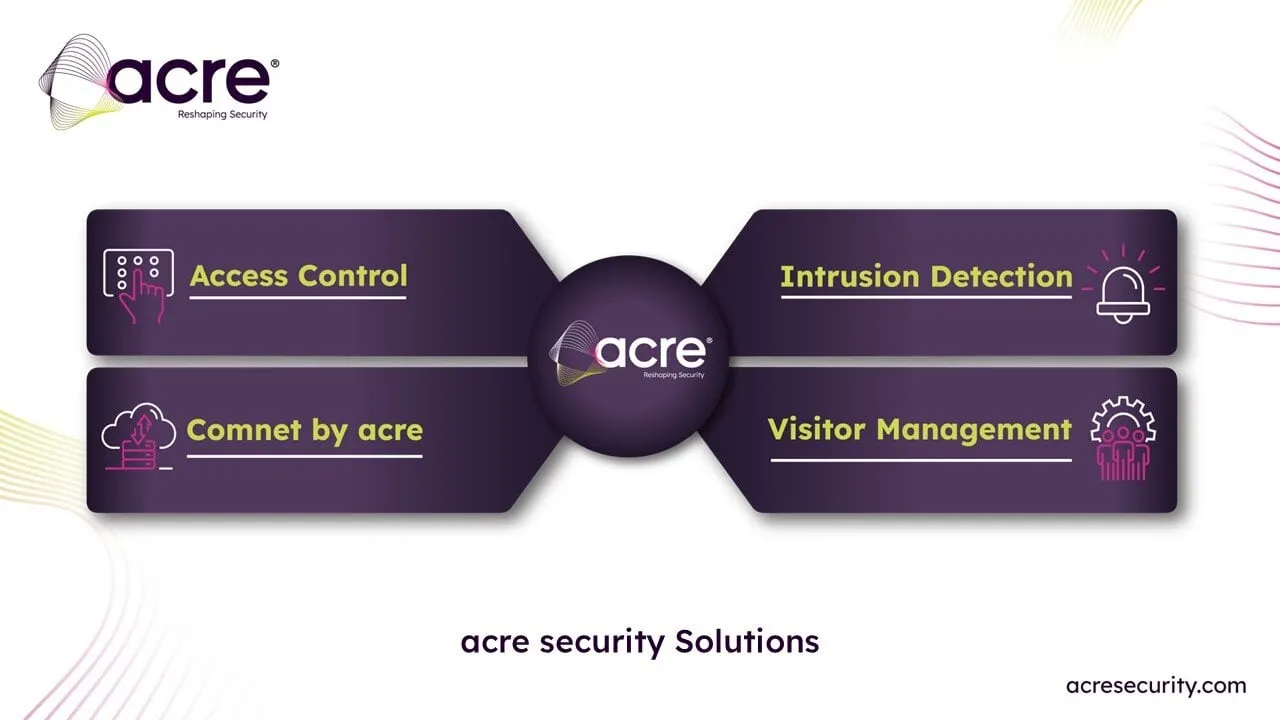
The four access control platforms above cover the entry point and credentialing layer. For commercial buildings that need a complete physical security system, Acre's broader portfolio extends across mobile credentials, visitor management, intrusion detection, and network infrastructure — all designed to work together. In fact, Acre is ranked among the best intrusion detection systems for security.
Acre Wallet — mobile credentials for staff and contractors
Acre Wallet replaces physical key cards and fobs with secure mobile access using BLE and NFC, protected by Face ID or fingerprint authentication. For commercial buildings with high staff turnover or large contractor populations, mobile credentials reduce the administrative overhead of physical card management. Lost credentials are deactivated instantly from the central platform. Temporary access for approved visitors can be issued and revoked remotely without on-site interaction. Read more here.
Enterprise Visitor Management — knowing who is in your building
Uncontrolled visitor and contractor access is one of the most persistent security gaps in commercial buildings. Acre's Enterprise Visitor Management integrates directly with Acre's building access control systems — pre-registered visitor credentials are automatically scoped to the relevant areas and time window, with watchlist screening on arrival and a complete audit trail for every visit. For property managers running multi-tenant buildings with high contractor volumes, automated credential lifecycle management removes the manual overhead that creates security gaps.
If the cost of maintaining your current building access control infrastructure — across hardware, credential management, and multiple disconnected systems — is harder to account for than it should be, then it is worth calculating what a unified, cloud-managed platform would cost over time. Use Acre's TCO Calculator: https://www.acresecurity.com/tco-calculator
Key Capabilities to Look for in Building Access Control Systems
Choosing the right building access control system is not just about the technology at the door. The capabilities below determine whether a system delivers genuine operational value — or creates new problems to manage. These are the specifications that matter most when evaluating commercial access control solutions.
Integration with existing security systems
A building access control system that operates in isolation from video surveillance, intrusion detection, and visitor management creates operational blind spots. Acre's access control integrates with leading VMS platforms including Milestone and OnGuard, with acre Intrusion for unified alarm and lockdown workflows, and with Comnet by acre for the network infrastructure that keeps everything connected and operational.
Scalability across access points and locations
Building access control systems must accommodate growth — more doors, more users, more sites — without requiring a platform change. Acre's cloud-based systems scale by configuration. Adding a new access point or building is a management change, not an engineering project. For property managers overseeing multiple locations, consistent access control policies are applied uniformly across every site from a single platform.
Audit trails and compliance reporting
Every access event should be logged with a timestamp, identity, and location. These audit trails are the primary evidence regulatory frameworks including GDPR and HIPAA require when access control systems collect personal data. Acre's platforms maintain comprehensive logs supporting compliance reporting, incident investigation, and security audits — with detailed reports generated on demand without manual data compilation.
Emergency response and lockdown capabilities
Building access control systems must perform reliably under pressure. Acre's access control supports system-wide lockdowns from a central dashboard or mobile device, with fail-safe and fail-secure door configurations that determine door behaviour during power loss. Mass notification capabilities ensure occupants and security personnel receive immediate alerts when a lockdown is triggered.
Common Mistakes When Implementing Building Access Control
Even well-resourced organisations make avoidable mistakes when implementing building access control systems. Most of them are not technical failures — they are decisions made early in the procurement process that become structural problems later. These are the most common ones, and what to watch for.
Choosing a system that cannot scale
A commercial access control system that cannot expand to cover additional access points, new buildings, or new credential types will need replacing prematurely — at significant cost and disruption.
Scalability should be a core specification from the outset. Adding doors, sites, and users should be configuration changes, not infrastructure projects.
Treating access control as a standalone system
A building access control system that does not integrate with video surveillance, intrusion detection, and visitor management creates fragmented security operations. When an access event cannot be correlated with other security data, response times are slower and investigations are harder. Prioritise access control solutions with verified integrations across your existing security systems.
Underestimating the ongoing management requirement
Access control is not a set-and-forget installation. Permissions need regular review, credentials need deactivating when people leave, and system rules need updating as operations change. Regular audits of access logs and permissions are essential to maintain effectiveness. Cloud-based building access control platforms with remote management significantly reduce this burden — Acre's centralized dashboard means administrators manage access across an entire estate without routine site visits.
Ignoring data privacy and compliance obligations
If your building access control system collects personal data — biometric information or access logs tied to named individuals — storage and processing must meet relevant regulatory requirements. Acre's cloud access control is aligned with GDPR and supports SOC 2 compliance for cloud deployments. ISO 27001 certification applies to specific parts of Acre's portfolio — verify scope for your deployment.
Secure Your Building with Acre Security
The right building access control system gives property managers and security teams precise control over who enters their building, where they go, and what record exists of every access event — without creating operational complexity. It integrates with the rest of your security infrastructure, scales as your estate grows, and maintains the audit trail your compliance obligations require.
Acre Security's access control solutions cover the full spectrum: cloud-native management for commercial buildings and multi-site estates, on-premises options for regulated environments, mobile credentials, integrated visitor management, and the networking infrastructure to keep it all running. Trusted by The Ritz London, Palo Alto Networks, Rockhurst University, global media company (150+ sites).
If your current building access control system is not meeting the security, compliance, or operational demands of your property, speak to an Acre specialist to find out what the right solution looks like for your environment. Talk to the Acre team: https://www.acresecurity.com/lets-talk
Different Types Of Building Access Control Systems Explained
There isn't just one way to control building access. You’ll come across several names and categories as you learn more about access control systems, including:
Discretionary Access Control
This is a flexible system where the owner of a resource (like a specific office or room) decides who can access it.
You’ll find it in smaller settings or for less critical facilities.
Mandatory Access Control
This is a stricter model often used in high-security environments like military or government facilities. Access is based on security clearances and classifications set by a central authority, not individual owners.
Role-Based Access Control
This system is popular in white collar businesses. Access is granted based on a person's role within the organization.
For example, only HR teams and senior management can unlock the storage room containing personnel files.
Rule-Based Access Control
This system uses specific rules or policies defined by administrators to determine access. These rules account for various factors like time of day, location, and access holder attributes.
You might also see this being called Policy-Based Access Control.
How Acre's Access Control Systems Work: Step-By-Step
Let’s get into the real detail of these systems, explaining the flow of information and action.
- Someone wants to enter a secured area and presents their access credential to the reader.
- The reader captures the information from the credential (e.g. reads an ID card or scans a fingerprint).
- The reader sends this information to the access control panel or controller.
- The controller checks the credentials against its database to verify the access holder and their authorizations.
- The controller grants or denies access.
- If access is granted, the controller unlocks the door to allow entry.
- The system logs the access attempt, reporting who tried to enter, where, and when. This creates an audit trail, which is essential for security.
- Good access control systems integrate with other systems like security cameras and alarms. With these integrations, specific events can trigger these systems into action. For example:
- Recording each entry plus ten seconds after in case of tailgating.
- Sounding an alarm and alerting security personnel/police to a break-in.
How To Design A Building Access Control System
Every building is different, with unique weak points and contexts. We can’t give you specific advice in this article because of that, but we can explain the fundamental questions to answer when designing your access control system.
Identify your security needs
What are you trying to protect? What are the potential threats?
Until you’re clear on what needs protecting, you won’t know how to protect it. Security priorities will differ significantly between prisons, banks, and public spaces like museums, where risk levels, access rules, and operational requirements vary widely.
Understand roles and access levels
Determine who needs access to which areas – based on their role, not the individual – and define their permission levels.
A role-based access system is robust and easy to maintain in the face of staff turnover.
Select the right access control technology
Choosing your credentials and reader can be tricky. You need an option that matches your level of risk, your budget, and ease-of-use for your staff. Finding a solution that ticks all three boxes isn’t easy.
Establish one priority factor and choose the system that best suits it. A business with many staff and regular turnover might need to prioritize a flexible, easy-to-use system at a higher cost. A business housing critical infrastructure might need to choose the most complex system that takes longer to operate than others.
Plan for scalability and future upgrades
Think about how your access control needs might change in the future.
If things go well for your business, can your system handle a dozen new users (and at what cost)? Can it be scaled across multiple locations?
If you need to scale back, are you tied into a long contract or expensive break clauses?
Best practices for managing access control systems
Once your system is in place, the real work begins. Security is an ongoing process, not a one-and-done task. Make time to:
Conduct regular audits
Review access logs, permissions, and system settings to identify any anomalies or potential vulnerabilities.
Depending on your risk tolerance, this could be weekly, monthly, or quarterly.
Train staff on access control protocols
Ensure all employees and administrators understand how the access control system works, security protocols, and their responsibilities.
This ties in with a wider need for awareness and upskilling in security. It might be a cliche, but it’s true: your system is only as secure as its weakest link.
Ensure data privacy and compliance
If your system collects personal data (like biometric information), you need to be sure that your storage and processing of that data meets regulations like HIPAA or GDPR.
Your system provider should be able to provide these assurances, but you should never assume.
Create an emergency response plan
Have clear procedures in place for how building access will work during emergencies such as lockdowns, power outages, or breaches.
Another cliche, another truth: if you fail to prepare, you’re preparing to fail.
Regularly update software and firmware
Keep your access control system's software and firmware up to date to patch security vulnerabilities and ensure optimal performance.
Your provider should be on top of this and, ideally, be pushing updates automatically. This isn’t always the case and there are some security risks that come with automatic updates. It’s worth consulting with your provider and security and IT teams.
Why use Acre Access Control for your building?
Protecting your premises requires a robust and reliable access control system. Those are the systems we develop and manage.
We offer a range of cutting-edge access control solutions that will protect your valuable assets and ensure the safety of your personnel. Working with Acre, you’ll be following in the safe footsteps of industry leaders including Mastercard, LinkedIn, and EDF.
Our systems are designed with scalability, integration, and user-friendliness in mind. Most importantly, we develop tailored solutions to meet your unique needs.
Learn more about our access control systems.
Secure your premises, business, and productivity
Building access control systems are vital in modern security management, providing a more sophisticated and secure barrier to entry than the traditional lock and key.
Understanding the different types of systems, their core components, and best practice design, you can significantly enhance the security and efficiency of your premises.
Ready to take the next step in securing your building?

.webp)
.png)
.png)
.png)